Showing posts with label how-to. Show all posts

The Freelance Writing Trenches: Follow-Up guest post

Tuesday, April 17, 2012
 Note from Ada: Today's installment of The Freelance Writing Trenches comes from Robert Lillegard, a college classmate of mine, and one of the most successful 20-something freelance writers I know. Over the years, Robert and I have kept in touch about our freelance success and headaches and I've always admired Robert's tenacity. There's a lot we call all learn from Robert when it comes to having a successful freelance career. 

The Importance of Follow-Up
By Robert Lillegard

I’ve been freelancing for about six years, but I’ve really started taking it more seriously in the last two. I’ve sold stories to the New York Times, Midwest Living, Relish, Latina, and a couple of major trade journals. One of the biggest things that has helped me along the way is something my editor at my day job told me: the persistent get published.

The simplest way I can say it is this:

Pester editors until they get back to you. 

I’m the online editor for Duluth~Superior Magazine, and I periodically get pitches for stories, emails from potential interns, etc. There are a few things I look for in those emails. I appreciate it when people get my name right. I appreciate it when people give off the impression that they have read our magazine—they don’t have to actually have read it, but they have to sound like they have (hint: this doesn’t mean saying “as I was reading your magazine, I noticed that you could use more articles”. It’s more like “Your Sojourn section has done stories on Bayfield and Ashland, but you haven’t yet covered Ely.”) And, I appreciate it when they send me polite follow-up emails checking if I’ve had a chance to look over their query yet.

Ok, appreciate is the wrong word. Frankly, those follow-up emails are pretty annoying, because they mean more work for me. But you know what? Half the time they’re the only emails I respond to. I’ll ignore the original email but after a follow up or two I basically always respond. There are a few reasons for this (for example, following up shows me a writer can be diligent, which makes a good impression) but the main one is this: it keeps the writer at the top of my mind. I’ll eventually write back, if only to say “no”, because that person took the effort to keep working on me.

The Lesson: Follow-up is key.

So, I apply this to my own writing as well. I track every query I send out with an Excel spreadsheet that has the date, subject of the query, the publication, and the editor’s name. If that sounds like a lot of work, come on—doesn’t it take you at least an hour to write a query? Even pitching a nearly identical query to a competing publication takes at least 10 minutes just to track down the editor’s name and email. So an additional 45 seconds to update your query log is really no big deal.

But, here’s where the query log is key. Make 5 extra columns and label them First Follow-Up, Second Follow-Up, Third Follow-Up, Fourth Follow-Up, and Phone Call. Then, send out your queries and wait. When no one gets back to you after two weeks, forward the editor your original query and at the top add something along these lines:  

Dear Mr. Morton, 

Just wanted to follow up with you about my story pitch on kayaking in the buff. I think it would be a perfect fit for the Give it a Try section of Naked Sports Magazine. Is this something you’d be interested in? 
Best, Frankie Freelancer

(You wouldn’t actually say Frankie Freelancer though, you’d say your name).

Then, under the First Follow-Up column, write the date you followed up. Continue the process, varying your follow-up emails just slightly, every couple of weeks until you hear back. If you keep not hearing back, give a polite phone call a try.

 Some places won’t ever get back to you. But if your queries are good and you’re targeting the right markets, this should really improve your response rate. I had to follow up with one magazine something like eight or nine times, but now I have a monthly column with them and I get a feature basically every month, too. Plus, of course, there’s the New York Times, which I try to mention at least twice every time I write something about writing. Whether you’re pulling $50 an article or $1 a word (or both if you write really short articles), following up persistently will help you get to the next level in your writing career.
Read more ...

Summer Stockpiling - Plus Making Dried Beans in a Crockpot Tutorial

Tuesday, April 3, 2012
When I moved away from home, I realized there are a few of basic grocery items that I'm not used to buying. My family has a definite "homemade" mentality, and when I was growing up, pizzas and lasagnas weren't pulled out of the freezer or ordered; they were made from scratch. Store-bought bread was an oddity in our house and we never, ever bought jarred spaghetti sauce. It was a sad day indeed if we ran out of homemade jam and had to buy a jar of strawberry preserves, or heavens help us, grape jelly. To this day, grape jelly still tastes like sadness to me.

Now that I'm on my own, I find I also lean towards making things from scratch. It's cheaper. It tastes better. It's more satisfying. And let's be honest, when I work from home like I do the majority of the year, it's pretty easy for me to live a "made from scratch" life.

When I'm home all day, I just don't find it very time consuming to make things from scratch. Homemade bread may require 3+ hours of time, but it doesn't require my undivided attention that whole time. It's easy enough to mix up the dough and leave it to rise to rise while I go do something else, then return to shape loaves, leave again to do whatever, pop the bread in the oven and go do something else while the bread bakes. If I'm smart about it, I can get a good 2 hours of work done during the whole bread baking process. I make my marinara sauce by throwing all the ingredients in a crockpot and let it burble away for 4-5 hours for a total hands-on time of 30 minutes. In fact, I use the crockpot as shortcut for lots of "made from scratch" stuff.

If I'm making this all sound like a snap, let me assure you that it all goes to hell in a hand basket when summer comes around. By mid-August, between working full time and berry picking, I pretty much give up on making things from scratch and I'm buying bread and spaghetti sauce along with everyone else. So every spring I come up with this great idea that I'm actually going stockpile the ingredients I like to make myself in the freezer and have enough to last through the busy summer season.  Honestly, I've never managed to pull this off, but I persist in thinking it's a really good idea.

One ingredient I prefer to prepare at home are beans. It's about half as expensive to make your own cooked beans from dried beans, rather buying cooked and canned beans. You can also better control how much sodium's in your bean recipes by making your own beans. And you can cook up large batches, which saves me the trouble of having to buy canned beans nearly every week. (We eat a lot of beans.)

The other day we were running low on frozen beans, so I cooked up a batch each of kidney, pinto, and garbanzo beans over the course of three days. Here's a pictorial guide to the last batch, the garbanzos.

Take your bag of approximately 3-4 pounds of garbanzos (I purchase my dried beans at the local co-op), dump into a colander and rinse with cold water. Pick through the beans and discard any rocks or broken beans. Dump the beans into your crockpot and cover with about four inches of cold water. Cover and place in the fridge overnight. 

The next morning your beans will have doubled in size. Dump them into a colander, than back into the crockpot and cover with fresh cold water. I usually have the water covering the beans by about an inch at this point.
 

Turn your crockpot on high and walk away. I put an old towel around the base of the crockpot to soak up the water that will inevitably boil over. Be warned, bean water does not smell great, so you'll want to wash that towel that in timely manner. (Lesson learned.)
Check on your beans after about 4 hours. I find it takes most beans between 4-5 hours to reach desired tenderness using this method. It's okay to turn off the crockpot a little before the beans are as tender as you'd like. Like pasta, the beans will cook as they cool in the colander.

Pour into a colander (or two) and cool. Divvy up into 1 3/4 cup portions in freezer bags. Throw in the freezer. Now you have bagged and frozen equivalents of canned beans for half the price!

You can thaw out the beans in the fridge before you use them, but honestly, I'm never that organized and usually just throw them in frozen into whatever recipe I'm making and increase the cooking time a bit. Remember, these aren't salted, so you may have to add extra salt to your recipe.

Now I've got a good summer stockpile of beans, but there's plenty of bread baking and sauce making if I'm really going to make it through the summer . . .

 
Read more ...

The Freelance Writing Trenches: Getting Started

Sunday, February 5, 2012
I spent a lot of time in my advisor’s and other professors’ offices during my college career, never more so than during the close of my senior year. Wedged between their book-lined walls, I chatted up my professors, mulling over my next move. Grad school? An attempt to grasp an elusive and rapidly disappearing 9-5 writing job with benefits?

As obtaining my B.A. (a double major in English and Communication) grew closer and closer, I realized that after four years in the idyllic hallways of Tower Hall (a building nicknamed “Hogwarts” for its striking Gothic architecture), I was as clueless about what came after college as I had been when I hiked up the four flights of stairs to my very first college class.

Well, maybe not quite as clueless.

During my college years, in addition to working towards my degree, I’d spent three years writing for and two years as news editor of the student newspaper. I’d spent four years working for and two year editing the college’s literary and artistic journal. I’d develop my writing skills and knew I wanted a career in writing. Yet, the summer between my junior and senior year, I’d lost an opportunity for an internship with a small city newspaper because the publication became unable to fund the position. 2007 was not a great year to immerge into the world as a young woman with a love of print media and an English degree.

Of course, there was one option that would allow me to write and earn an, albeit, meager living after college. I wouldn’t have benefits, but I also wouldn’t have to go through the heartbreak of having every single writing job I applied for be defunded before they even finished the hiring process.(True story.) But I never discussed that option with my professors. It seemed too ridiculous. Who graduates from college wanting to be a freelance writer?

A friend emailed over the weekend to ask how exactly you get started as a freelance writer. I had to pause for a moment and think about how I began, because honestly, I’ve been kicking around the freelance writing thing since I was in high school.

So how do you approach dipping your toe in freelance writing? If I were to do it in a linear manner, here's what I'd recommend.

1) Get a consistent writing gig where you write for someone else. Don’t worry about getting paid for this gig. Your job here is to learn the joy of deadlines and experience some times eye roll-inducing interactions with editors. If you’ve worked on a school newspaper, helped edit a newsletter or journal, or anything of this nature, you can probably skip this step. I spent several years, both in high school and college, writing and editing for the online teen ezine kiwibox.com. Yes, kiwibox. It sounds ridiculous, but during that time I wrote literally 100+ articles and edited just as many. It was truly invaluable experience, no matter how silly it sounds now.

2) Amass your resources. I believe every would-be freelance writer should have a subscription to some writing magazine (I got Writer’s Digest), a subscription to Hope Clark’s e-newsletter Funds for Writers, and the latest version of Writer’s Market.

Got those? Good – immediately proceed to step 3. It’s just too tempting to use resources as a diversion from the actual freelance writing work.

3) Start pursuing paid gigs through queries and submissions. I started querying on an extremely fair weather basis during the summer of 2005. I got a couple nibbles, but no bites. I did however learn how to write a decent query letter. I sold my first article in 2008. Then another one in 2009. Then I got a regular writing gig. It's not a fast process, but just like driving home in the fog with one headlight, it'll get you there.

There is no (I repeat, no!) magic process you must follow to become a freelance writer. But there are two things you must do if you’re serious about making money as a writer:
  • Pursue publications for paid writing possibilities.
  • Write. 
Simple?

We wish!


Read more ...

Tofu: Terrible, Terrific, or Tolerable? Tofu Tuesday Tutorial 1!

Tuesday, March 29, 2011
I got a lot of reactions when I posted the quip above a couple weeks ago as part of a "semi-wordless Wednesday" post and I think I might have been slightly misleading. I don't really think tofu tastes like wallpaper paste, although it is a pretty unappealing substance when left to its own devices.  

In an attempt to convert all you tofu-naysayers into tofu enthusiasts, I'm embarking on a multi-week Tofu Tuesday Tutorial. In this four week series, we'll cover how to convert that suspicious white blob of soy into something truly (cross my heart!) delicious.

Ready for today's tutorial? Here we go . . .

Tofu Tuesday Tutorial 1:  It's Actually Pretty Good When It's Pretending to Be Something Else . . . aka Sloppy Toes. 

The post below was originally posted at The Happy Home

I grew up in a vegetarian household and ate probably far more than my fair share of tofu dogs as a child. My parents were Diet for A Small Planet generation vegetarians, where it was still believed that vegetable protein was slightly inferior to meat protein and vegetarian cooking was treated as some sort of complex geometry proof. As we grew, my brother and I tasted many recipe hits and misses (barbequed tofu was not a hit) as vegetarian cooking evolved. The joyful result of all those culinary experiments was some adventurous taste buds and the knowledge that food could be just about anything you wanted it to be.

Now that I’m on my own, I’ve incorporated meat into my diet, but we still prepare a large number of meatless meals at the cabin. When we do eat meat, I prefer to purchase organic, free-range chicken and we avoid beef and pork.

Despite the fact that we rarely (if ever) have ground beef in the house, we eat Sloppy Joes on a regular basis. The secret is a childhood recipe which uses tofu in lieu of ground beef. Years ago, my father dubbed the recipe “Sloppy Toes” and the off-putting nickname stuck.  

One bite of this yummy sandwich filling will thwart that inevitable question asked of all vegetarians: “Where’s the beef?” I’ve used the recipe to help tofu-phobic roommates overcome their resistance to soy protein. It’s a great kid-friendly, weekday meal that uses everyday ingredients and happens to be vegan too. The only thing you need to remember is to pull the tofu out of the freezer night before.

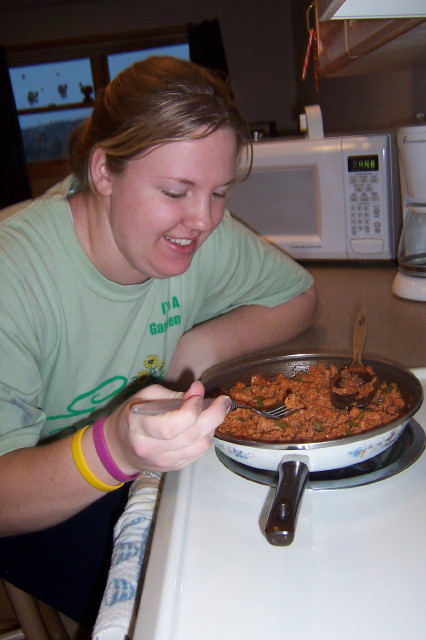
Over the years, I've tried to initiate others into the world of Sloppy Toes, with mixed results. Here's my tofu-phobic college roommate Sarah testing it out. (Please note, I was unsuccessful in this Joes to Toes conversion attempt.)
Look at that unbridled enthusiasm!
"Do  I really have to eat this?"
Mmm, delicious!
Try taking the Joes to Toes challenge yourself!  

Sloppy Toes
1 lb. extra firm tofu, frozen and defrosted*
2 tablespoons tamari (or other soy sauce)
1 tablespoon vegetable oil
1 medium onion, chopped
1 stalk celery, chopped
½ medium green pepper, chopped
1 cup ketchup
2 teaspoons vinegar
2 teaspoons lemon juice
2 teaspoons prepared mustard
2 tablespoons brown sugar
Squirt of hot sauce (I use Sriracha)

Squeeze excess moisture from tofu. (I usually place the cake of tofu between two plates in the kitchen sink and place a heavy object – like a bag of sugar – on top of the top plate to press some of the moisture out. Then I use my hands to get the remaining moisture out.) Tear tofu into small crumbles. Place in a bowl and mix with tamari. Set aside.

Saute onion, celery, and green pepper in oil. After about five minutes, or when onions are soft, add tofu and brown lightly for a minute or two. Meanwhile mix up a sauce of the remaining ingredients. Add sauce to tofu and heat gently for a half hour. Serve on sandwich buns.

*We’ve always used frozen, then defrosted tofu because it seems to have a crumblier texture closer to that of ground beef that tofu used fresh out of package.
Read more ...
Related Posts with Thumbnails